Decode a memory from the brain's wiring
The Challenge: decode a non-trivial memory from a static map of synaptic connectivity — perhaps the ultimate test of whether we truly understand how memory works.
The Memory Decoding Challenge
Research over the last 100 years has identified the key structural and molecular building blocks of neuronal computation. Recent years have seen an explosion of new techniques:
- Large-scale recording and manipulation of neuronal ensemble dynamics
- Tagging and optogenetic manipulation of cellular and synaptic memory engrams
- Advanced techniques for probing the structural and molecular changes underlying learning and memory
- Automated electron-microscopic mapping of dense synaptic connectivity (synapse-resolution connectomics)
We believe these parallel advancements in technique and theory have set the stage for a major milestone in neuroscience: the first demonstration of decoding a non-trivial memory (or other learned function) from only a static map of synaptic connectivity. Today’s theories of brain function and memory strongly imply that such decoding should be possible, and large-scale synapse-resolution connectome mapping has finally provided the tools to put these theories to the test.
Awards & prizes for memory research
Two awards honor the field's milestones — and the ultimate challenge.
Four Annual Research Awards
To honor and highlight research into how learning and memory are physically encoded in the brain.
Memory Decoding Challenge Prize
To the first team to decode a non-trivial memory from a static map of synaptic connectivity.
Discussion Group
A private, invitation-only email discussion group for neuroscientists to discuss relevant research, nominate papers, and decide what precisely should qualify as a successful decoding of a non-trivial memory.
Yearly Meetup
Bringing together researchers across neuronal ensemble dynamics, memory engrams, molecular mechanisms, synapse-resolution connectomics, and theoretical and computational neuroscience.
Bringing together researchers across different neuroscience disciplines
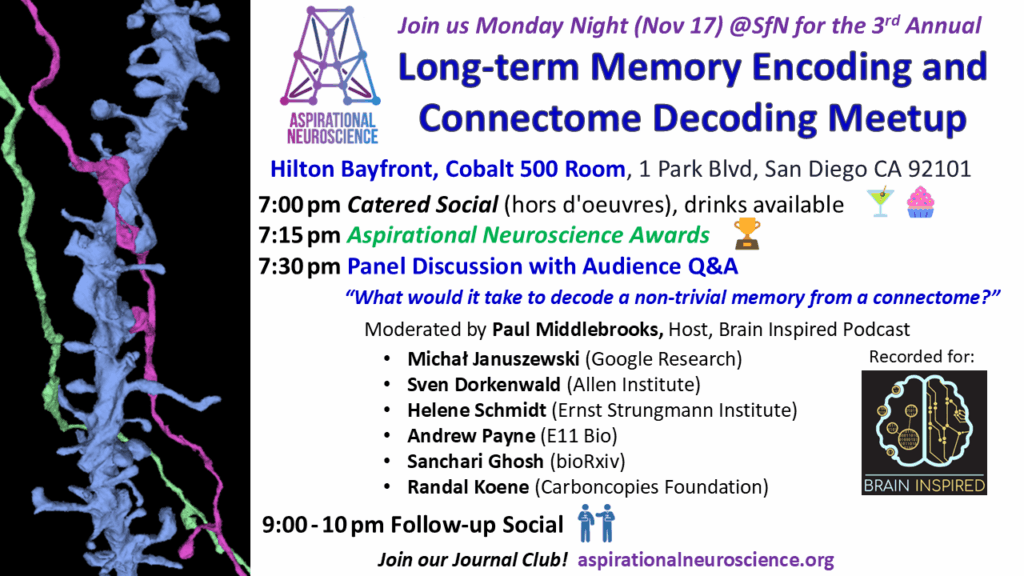
Each year our conference and SfN reception bring together experimental and theoretical researchers working toward decoding memory from connectivity.
See upcoming events →Memory engrams
Tagging and manipulation of cellular and synaptic memory engrams.
EM connectomics
Automated, high-throughput, synapse-resolution connectomics.
Molecular basis of memory
Structural and molecular changes underlying learning and memory.
Neuronal activity decoding
Recording, decoding, and manipulation of neuronal ensemble dynamics.
Theoretical neuroscience
Models of biological neuronal function, including still poorly understood phenomena such as oscillations and field couplings.
Computational neuroscience
Biophysically realistic neural simulations and comparisons to artificial neural network research.
Reasons for our prizes
The Memory Decoding Prize
The current consensus is that the vast majority of long-term learning and memory is encoded in the patterns and strengths of synaptic connections among neurons. But doubt remains, because most experimental evidence is indirect. Decoding a memory from connectivity alone is a powerful test of the quality of our theories of learning and memory.
Yearly Awards
It is anticipated that it will take many years for any lab to claim the Memory Decoding Prize. Because of this, we offer a set of four smaller Research Awards each year to highlight and honor important research into the physical and functional basis of learning and memory.
Help test our theories of memory
Join our fortnightly Journal Club, nominate a paper, or support the prizes. Students, postdocs, and researchers across neuroscience and allied fields are welcome.