Honoring research that brings memory decoding within reach
A visionary anonymous donor has funded our current awards and prizes.
Memory Decoding Challenge Prize
Offered to the first author of the team that makes this historic achievement, upon publication in a peer-reviewed scientific journal. There is no time limit for this award.
Annual Research Awards
Currently US $25,000 each (split equally among co-awarded papers, then among co-first authors). Four awards are offered each year, typically around the Society for Neuroscience meeting in November. Current philanthropic commitments will hopefully allow us to offer these annual awards until 2030.
The Aspirational Neuroscience Awards exist to honor and highlight groundbreaking research into how learning and memory are physically encoded in the brain. These awards are highly competitive, with consideration given to all peer-reviewed neuroscience publications worldwide since the previous ceremony. So far the awards have been offered three times (2019, 2023, 2025), and they will be awarded again in 2026 and annually thereafter. Awards are granted on the scientific impact, originality, and rigor of the work, with a central criterion that the research represent a significant milestone in either the understanding of, or the tools to examine, the neurophysiology of memory.
Previous award winners
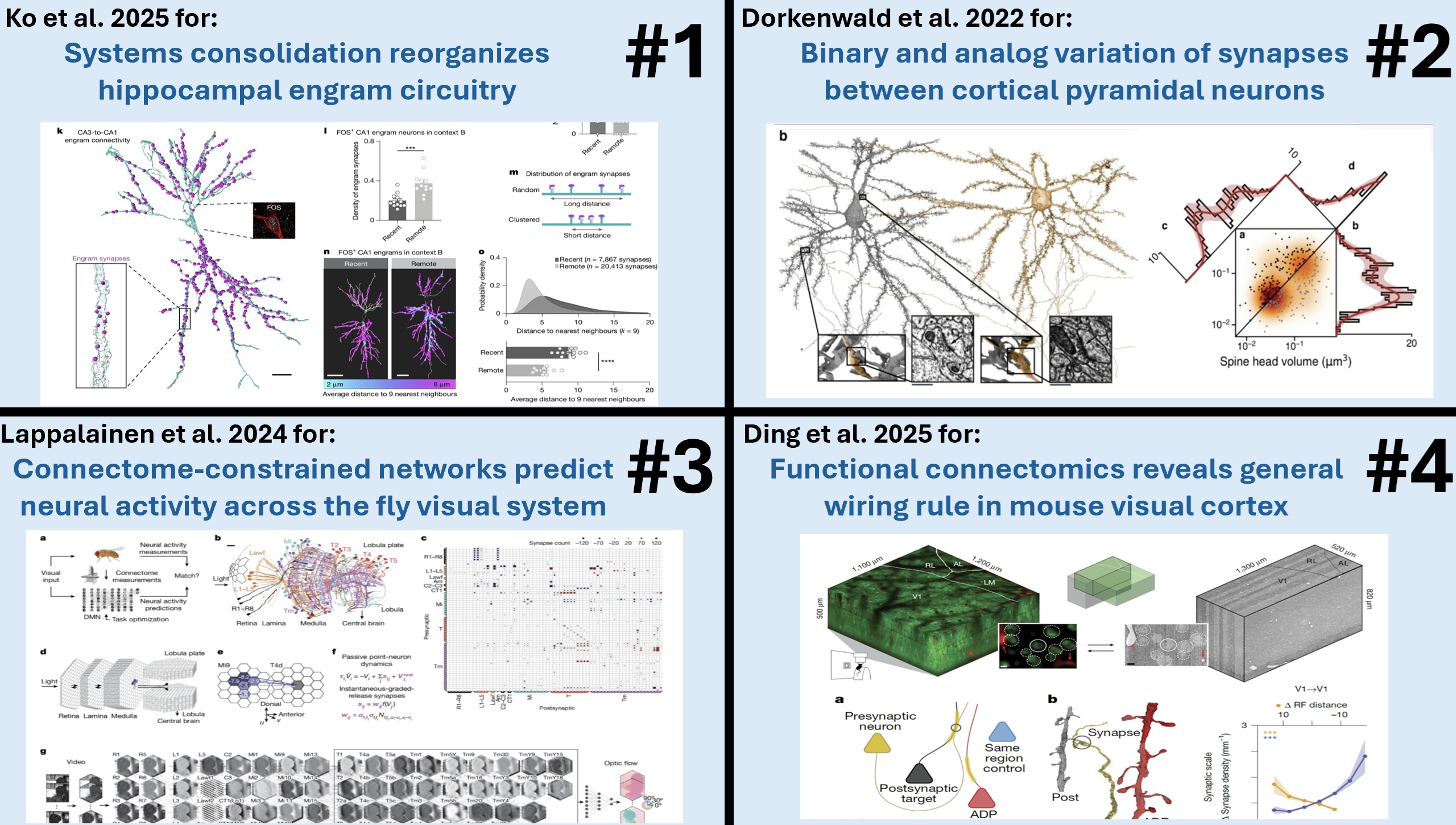
Showed that the shift in episodic memory precision from specific to general—usually attributed to cortical consolidation—may be partly explained by synaptic reorganization within the hippocampus itself. Using engram-cell tagging together with eGRASP synapse labeling, the authors tracked the synaptic modifications underlying gist-memory formation — impressively, following a memory's change by tracking its synaptic changes.
Traced and proofread 1,960 synaptic connections among 334 pyramidal neurons in layer 2/3 of mouse visual cortex and quantified each synapse's size (and thus strength). Pairs of synapses sharing the same pre- and post-synaptic partners revealed a bimodal distribution best modeled as a binary value (small or large) plus uncorrelated analog variation — evidence that Hebbian learning may operate with essentially two synaptic strengths.
Demonstrated a way to predict function from a static map of synaptic connectivity even when many neuronal and synaptic dynamics are unknown. A differentiable model of the fly visual system, constrained by full EM connectivity, had its unknown parameters tuned by gradient descent to match the known motion selectivity of a subset of neurons — showing how the strong constraints of a connectome can be leveraged even without complete dynamics.
From the MICrONS cubic-millimeter EM volume with matched in vivo calcium imaging, the authors asked whether neurons with similar response properties are preferentially connected. Normalizing for axon–dendrite proximity and using a digital twin to quantify each cell's tuning, they found that cells with similar feature tuning are more interconnected than expected, while cells with similar location tuning are less interconnected — a striking general wiring rule.
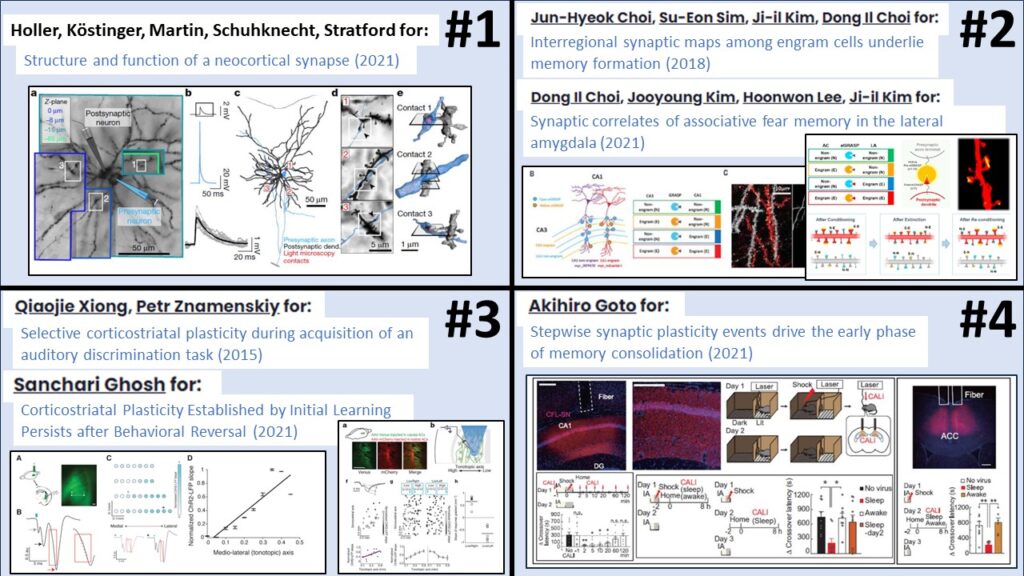
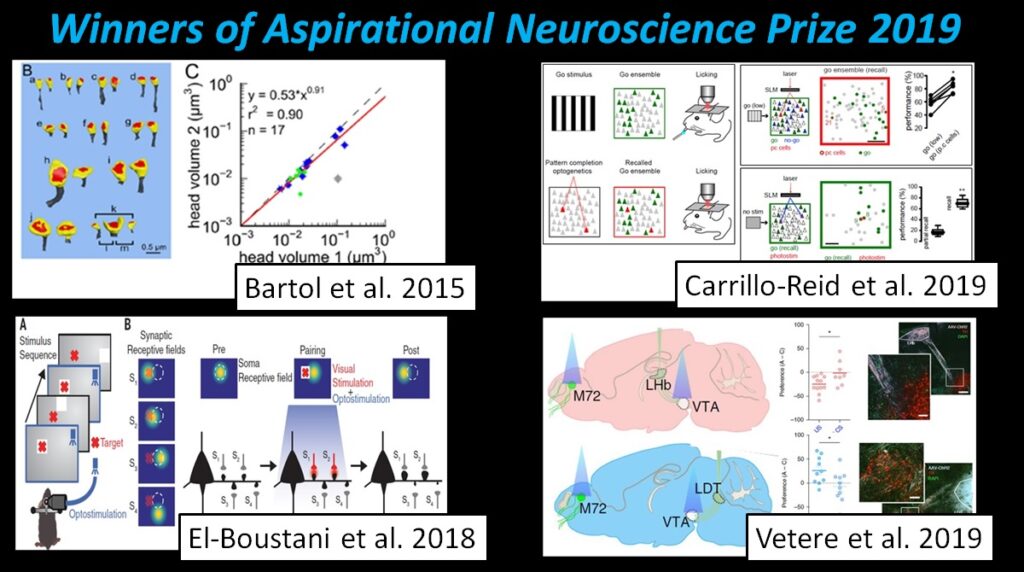
Found a linear relationship between synapse size and strength, providing the missing link in assigning physiological weights to synapses reconstructed from electron microscopy — a key step on the path to decoding information from static brain structure.
The first studies to visualize and quantify the "synaptic engram" in the hippocampus and amygdala — an essential mechanism by which memory is stored — demonstrating how memory strength correlates with the number and size of synapses among engram cells.
Revealed how the brain establishes and maintains learned sound–action associations through selective strengthening of corticostriatal synapses, and showed these patterns persist even after behavioral reversal.
Revealed the precise spatiotemporal choreography of synaptic plasticity during memory consolidation and introduced an optogenetic tool for selectively erasing LTP with unprecedented temporal precision.
Thank you, neurophilanthropists
Are you a philanthropist interested in advancing humanity's understanding of complex, high-value questions in neuroscience? Would you like to grow the size or visibility of AN prizes, or establish other research prizes? We'd love to talk with you.